
The off-season golf fitness program is a golden window for golfers to lay the groundwork for their best year yet. While plenty of players let their fitness fade as temperatures drop, savvy golfers see this time as a chance to gain strength, power, and mobility—the stuff that separates the good from the great.
A structured off-season fitness program can add 15-20 yards to your drives while reducing injury risk and helping you play more consistently across your bag.
Participating in an off-season golf fitness program can add 15-20 yards to your drives while reducing injury risk and helping you play more consistently across your bag.

Professional golfers don’t just keep their fitness ticking over in the off-season—they treat it as their main training block. That’s when they build new capabilities. The same 12-week periodized approach that tour players use can totally change your game come spring.
Engaging in an off-season golf fitness program allows professional golfers to not just maintain their fitness but to treat it as their main training block.
This method targets the muscle groups and movement patterns that matter most for golf.
Your off-season training should focus on three key areas: building rotational power for
Why Off-Season Golf Fitness Matters

The off-season is your best shot to build strength, get more mobile, and develop power without worrying about your scorecard. Training smart now leads to longer drives, more consistency, and fewer injuries when you’re back on the course.
Taking on an off-season golf fitness program is your best shot to build strength, get more mobile, and develop power without worrying about your scorecard.
The Benefits of Off-Season Training
Off-season training matters for golfers because you can focus on your body instead of your swing. There’s finally time to work on strength and mobility that actually translate to better golf.
Participating in an off-season golf fitness program allows you to focus on your body instead of your swing.
Physical improvements include:
- Increased swing speed through rotational power
- Better balance and stability throughout your swing
- Enhanced flexibility for a fuller shoulder turn
- Stronger core muscles for consistent ball striking
Winter conditioning is essential for staving off the fitness backslide that often comes with months away from the game. Your body keeps its golf-specific strength and movement patterns sharp.
Joining an off-season golf fitness program is essential for staving off the fitness backslide that often comes with months away from the game.
Power training is particularly important now. You can do explosive movements like medicine ball throws and plyometrics. These build the fast-twitch muscle fibers you need for serious clubhead speed.
Adopting an off-season golf fitness program helps you to do explosive movements like medicine ball throws and plyometrics.
Common Mistakes to Avoid
Some golfers treat the off-season as total downtime. When you do that, you come back weaker and stiffer.
Avoid these training errors:
- Only doing general fitness instead of golf-specific movements
Participating in an off-season golf fitness program helps avoid only doing general fitness instead of golf-specific movements.
- Skipping mobility work and focusing just on strength
- Diving in too hard without a base
- Forgetting about injury prevention
Another misstep? Training without a plan. Random workouts won’t give you the steady progress you need. You’ve got to build from basics to more complex exercises.
Don’t ignore your weak spots. If your hips are tight or your core is lacking, focus on those instead of brushing them aside.
Setting Clear Off-Season Goals
Establishing an off-season golf fitness program means your goals should be specific and measurable.
Your goals should be specific and measurable. “Get stronger” isn’t enough to guide your training.
Set measurable targets such as:
Measurable targets for your off-season golf fitness program could include: Add 10 yards to your driver distance.
- Add 10 yards to your driver distance
- Improve hip rotation by 15 degrees
- Complete 18 holes without back pain
- Increase your plank hold time to 90 seconds
Write down your goals and check your progress every week. It’s a simple way to stay motivated when you’re not playing as much.
Stick to two or three main goals. Trying to fix everything at once just waters down your results.
Ready to dive deeper into age-specific training strategies? Learn why golfers over 40 need a completely different approach →
Core Principles of Golf Fitness Programs

Effective golf fitness programs zero in on three big areas: functional movement, mobility for proper swing mechanics, and the balance between explosive power and lasting energy over 18 holes.
Building Functional Strength
Functional strength training gets your muscles working together, just like they do in your golf swing. It’s all about training movement patterns, not just muscles in isolation.
Your swing needs your legs, core, and upper body to coordinate. Strength training programs should focus on compound exercises that mirror these patterns.
Key functional exercises include:
- Squats for leg drive and stability
- Deadlifts for hip hinge movement
- Rotational movements with resistance bands
- Single-leg exercises for balance
Unilateral training matters. Golf swings put uneven stress on your body, so single-arm and single-leg work helps even things out.
Core stability is huge. Your core is what transfers power from your lower body to your upper body in every swing.
Golf-Specific Mobility and Flexibility
Good flexibility lets you hit those ideal swing positions without cheating. If you’re stiff, your body compensates, and you lose power and accuracy.
The thoracic spine is especially important. That’s where you get your rotation for both backswing and follow-through.
Priority mobility areas:
- Shoulder internal and external rotation
- Hip flexion and extension
- Thoracic spine rotation
- Ankle dorsiflexion
Dynamic stretching is best before you train or play. Save static stretching for after workouts or in separate mobility sessions.
Flexibility exercises should be held for 30 seconds when you’re doing static work. That gives your muscles time to adapt and lengthen.
Integrating Power and Endurance
Power training builds explosive strength for more distance. Endurance training helps you maintain good swings all the way through the last hole.
Power exercises should match the speed and movement of your swing. Think medicine ball throws and plyometrics for those fast-twitch fibers.
Your cardiovascular system needs enough gas to keep your focus and swing mechanics sharp. If you run out of steam, mistakes pile up late in the round.
Power training guidelines:
- 3-6 repetitions per set
- High intensity with full recovery
Understanding the components of an off-season golf fitness program is crucial for effective training.
- Explosive movement patterns
Endurance training options:
- Steady-state cardio 2-3 times weekly
- Circuit training mixing strength and cardio
- HIIT workouts for time efficiency
Keep a balance between power and endurance work. Do your power training early in the session, when your nervous system is fresh.
Want to master rotational power? Discover the secret to consistent ball striking every time →
Phases of the Off-Season Golf Fitness Program
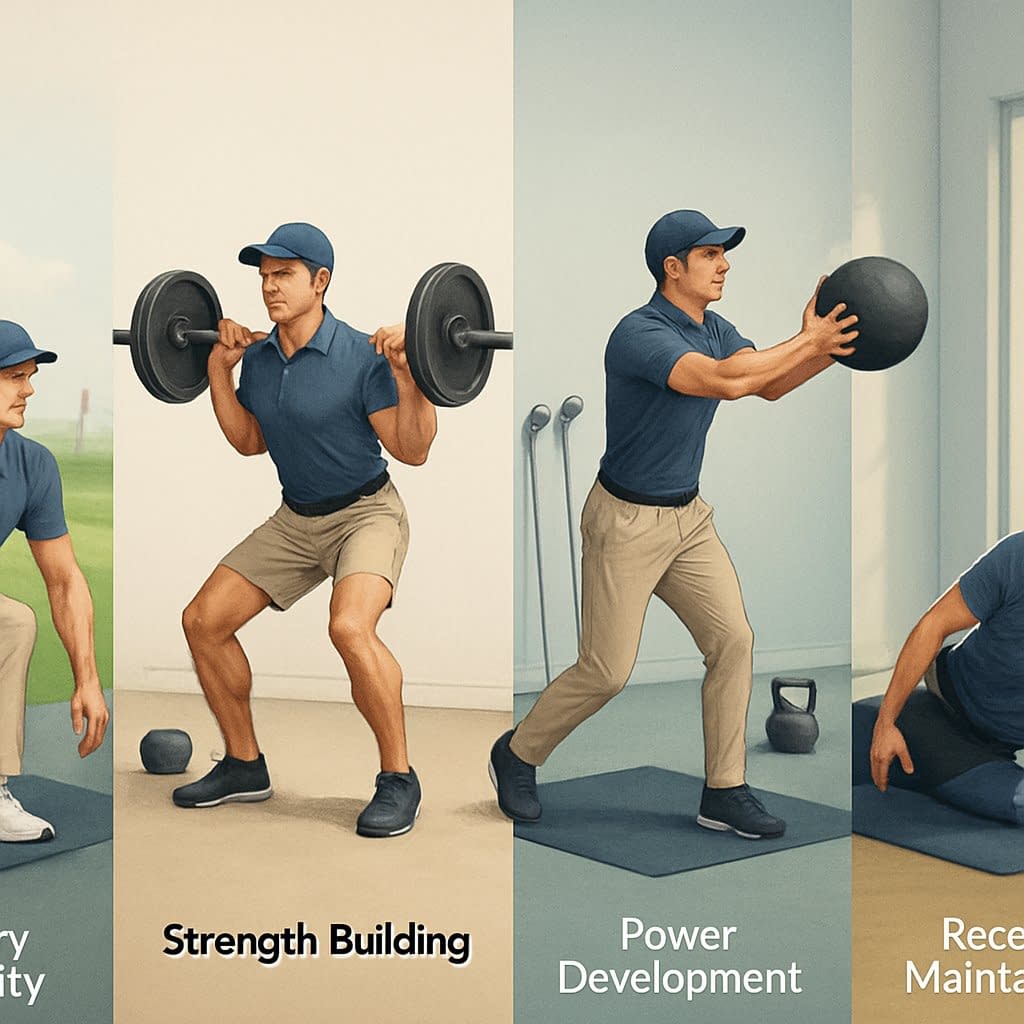
A solid off-season program has four phases. Each one builds on the last, targeting specific fitness skills and getting you ready for the next step.
Foundation Phase: Stability and Mobility
A strong off-season golf fitness program includes foundational stability and mobility work.
This first 4-week phase focuses on fixing imbalances and getting your body moving well again. Golf puts a lot of one-sided stress on you, so you need to address that before ramping up intensity.
Week 1-2 Focus:
- Joint mobility exercises
- Core stability training
- Postural correction work
- Light resistance exercises
Do unilateral exercises to train each side separately. It’s a good way to spot and fix strength differences between your lead and trail sides.
Key Exercise Types:
- Single-leg squats and lunges
- Side planks and bird dogs
- Hip flexor stretches and thoracic spine rotation
- Glute activation exercises
Flexibility work is critical now. Spend 15-20 minutes a day on dynamic stretching and mobility—especially for your hips, shoulders, and thoracic spine.
Stick to moderate rep ranges (8-12 reps). That builds endurance and lets your joints ease into things safely.
Strength Building Phase
In weeks 5-8, shift the focus to building raw strength. Use the mobility gains from phase one and start lifting heavier with fewer reps.
Training Parameters:
- 3-6 repetitions per set
- 3-4 sets per exercise
- Focus on compound movements
- Rest 2-3 minutes between sets
Workouts now emphasize squats, deadlifts, and pressing. These moves hit multiple muscle groups and build the kind of strength golf actually uses.
Heavier weights fire up more motor units in your muscles. That gets your nervous system ready for the power work coming up.
Primary Exercise Categories:
- Lower body: Squats, deadlifts, step-ups
- Upper body: Bench press, rows, overhead press
- Core: Weighted planks, Russian twists
Power Development Phase
In weeks 9-12, convert your new strength into explosive power. This phase uses overspeed and overload techniques.
Overspeed Training:
- Medicine ball throws
- Plyometric exercises
- Speed stick training
- Jump variations
Overload Training:
- Heavy compound lifts
- Resistance band work
- Weighted rotational exercises
Power training needs full effort and plenty of rest. Keep reps low (3-5) and rest fully between sets.
Quality beats quantity here. Each rep should be as fast and explosive as you can make it.
Peak Performance and Transition
The last 2-4 weeks get you ready for regular play. Training volume drops, but you hang on to your gains.
Work on golf moves at higher speeds. Mix in light technical practice and cut back on gym time.
Transition Activities:
- Light swing practice
- Putting and short game work
- Flexibility maintenance
- Sport-specific conditioning
This phase lets your body recover from the heavy lifting while keeping you sharp. Ideally, you’ll hit the new season feeling stronger and more explosive than ever.
Worried about losing swing speed? Here’s how to maintain your power as you age →
Strength Training Strategies for Golfers

Building golf-specific strength takes targeted exercises that boost your swing and keep injuries at bay. The real key is mixing compound movements with progressive methods that actually help you play better when you’re out on the course.
Designing Golf-Specific Strength Workouts
Your strength workouts should target the muscles that matter most in golf. Focus on your core, shoulders, hips, and legs—these areas really drive your swing power.
Plan on three strength sessions per week during the off-season. Each workout should last around 45 to 60 minutes.
Start with exercises that build stability first. Add power movements only after you’ve laid down a solid base.
Professional golfers follow rigorous workout routines built around strength, flexibility, and athleticism. It’s not all brute force; it’s about moving well, too.
Include rotational exercises that mimic your golf swing. Medicine ball throws and cable rotations are great options once you’re comfortable with the basics.
Key muscle groups to target:
- Core muscles for stability
- Glutes for hip power
- Lats for swing control
- Shoulders for club speed
Schedule rest days between sessions. Your muscles need time to recover and actually get stronger.
Compound Movements for Total-Body Strength
Compound exercises hit multiple muscle groups at once. These build the kind of strength that shows up in your golf swing, not just in the gym.
Essential compound exercises:
- Squats – Build leg and hip power
- Deadlifts – Strengthen your posterior chain
- Pull-ups – Develop lat strength for swing control
- Push-ups – Build chest and shoulder stability
Standard workouts with compound movements like bench press, deadlift, squat, and overhead press lay a strong foundation.
If you’re new to strength training, start with bodyweight versions. Only add weight once you’ve nailed the movement patterns.
Do compound exercises early in your workout, when you’ve got the most energy. Good form and focus really matter here.
Progressive Overload Principles
Progressive overload just means you gradually make your workouts tougher. That’s how your muscles adapt and get stronger over time.
When you can finish all your sets with good form, bump up the weight by 2.5 to 5 pounds each week. Keep track of your progress in a workout log—it’s easy to forget otherwise.
The key to real strength gains is adding more weight or reps each week, even if it’s just a little.
You can also progress by adding more reps or sets. For example, if you’re doing 3 sets of 8 reps, try 3 sets of 10 before you add more weight.
As you get stronger, power training becomes important. Explosive moves like jump squats and medicine ball slams help turn strength into golf-specific power.
Switch up your rep ranges every 4 to 6 weeks. It keeps things fresh and helps you avoid plateaus.
Ready to protect your most vulnerable area on the course? Learn how to bulletproof your back with proven strength training strategies →
Power Training for Greater Distance

Power training builds that explosive strength you need for faster swings and longer drives. The trick is mixing rotational movements with plyometrics, then using those gains in specific swing speed drills.
Rotational Power Exercises
Medicine ball exercises develop the explosive rotation your golf swing craves. These moves train your core to generate power in the same directions you swing.
Cable woodchoppers are a must for rotational strength. Set the cable at chest height and rotate across your body with control. Do 3 sets of 10 reps each direction.
Medicine ball slams fire up your core and arms. Lift the ball overhead and slam it down hard. Go for 4 sets of 8 reps, really bringing the energy.
Rotational medicine ball throws against a wall mimic your swing. Stand sideways to the wall and throw using your core. Try 3 sets of 8 throws from each side.
These moves should feel explosive. Rest 60-90 seconds between sets so you can keep the quality high.
Plyometrics and Speed Work
Plyometric exercises train your muscles to produce force quickly—exactly what you want for more swing speed and distance.
Jump squats are all about lower body explosiveness. Jump as high as you can from a squat, land softly, and go right into the next jump. Do 4 sets of 6.
Box jumps build vertical power. Step down between jumps instead of jumping down to save your knees. Complete 3 sets of 5 jumps onto a 20-24 inch box.
Clap push-ups work upper body explosiveness. Push up hard enough to clap your hands before landing. Aim for 3 sets of 5 reps.
Give max effort during the explosive part of each move. With plyometrics, quality beats quantity every time.
Translating Power Gains to the Golf Swing
Speed training drills help you use your gym gains for real swing speed. These bridge the gap between your workouts and your golf game.
Overspeed training with lighter clubs gets your nervous system moving faster. Swing an alignment stick or a weighted training club as fast as you can. Go for 10 swings, resting for 30 seconds between each.
Step-through swings add momentum to your swing. Take a big step forward with your lead foot during the downswing. It’s a bit awkward at first, but it helps boost hip rotation speed.
Practice these drills 2-3 times a week during the off-season. The movement patterns you build now will stick when you’re back on the course.
Ready to add 20+ yards to your drives? Get the complete core power training system →
Flexibility and Mobility Enhancement

Proper flexibility training is the backbone of a smooth, powerful golf swing—and it’s your best bet for avoiding injuries. Dynamic warm-ups get your body moving, while targeted stretches and mobility drills build the range you need for consistency.
Dynamic Warm-Ups for Golf
Kick off every session with dynamic moves that prep your muscles for golf. These movements boost blood flow and wake up the muscle groups you’ll use in your swing.
Arm circles wake up your shoulders. Start with small circles and get bigger. Do 10 forward and 10 backward.
Leg swings get your hips ready to rotate. Hold onto something for balance and swing each leg forward and back 10 times, then side to side 10 times.
Torso twists activate your core. Stand with feet shoulder-width apart and rotate left and right 15 times, keeping your hips facing forward.
Walking lunges with rotation combine lower body work with spinal mobility. Step into a lunge, then rotate your torso toward your front leg. Do 8 lunges per side.
Key Golf Flexibility Drills
Hit the muscle groups that really affect your swing with these flexibility moves.
The cat-cow stretch is great for spinal mobility. Start on hands and knees, arch your back and lift your head, then round your spine and tuck your chin. Go for 10 reps.
Hip flexor stretches boost rotation and weight transfer. Kneel in a lunge and push your hips forward. Hold 30 seconds each side.
Shoulder cross-body stretches help you keep a good swing plane. Pull one arm across your chest and hold for 30 seconds, then switch.
Seated spinal twists increase your rotational range. Sit with legs out, cross one leg over, and twist toward the bent knee. Hold for 30 seconds each side.
Improving Range of Motion Safely
Take your time building flexibility—rushing leads to injuries. Hold static stretches for 30-45 seconds so your muscles actually lengthen.
Never bounce or push past your comfort zone. You want to feel a gentle stretch, not pain.
Stick with short, daily sessions instead of cramming it all in at once. Golf mobility training really pays off if you’re consistent over a few months.
Check your progress by measuring shoulder turn and hip rotation each week. A mirror or video helps you spot any weird form issues.
Struggling with swing mechanics? Master the hip mobility blueprint for perfect form →
Injury Prevention and Warm-Up Routines

Most golf injuries come from overuse, not single events. That’s why warm-ups and prehab exercises matter so much for staying healthy long-term.
Recovery routines and catching problems early keep your performance up as you train.
Prehab Exercises for Golfers
Low back and wrist injuries are the most common in golf. Strengthen these areas with targeted prehab before issues pop up.
Key Prehab Movements:
- Thoracic spine rotations – 10 each way daily
- Hip internal rotation stretches – 30 seconds per side
- Glute bridges – 2 sets of 15 reps for lower back support
- Wrist flexor/extensor stretches – 20 seconds each
The modified robbery drill is great for shoulder stability. Stand in a mini squat, hold resistance band handles with elbows at 90 degrees, and rotate arms outward while squeezing your shoulder blades.
Do these exercises 4-5 times per week in the off-season. They only take 10-15 minutes and can really cut down injury risk.
Safe Stretching and Cooling Down
Dynamic stretching works best before golf. Save static stretching for after workouts to help recovery.
Your flexibility affects your swing and helps prevent injuries.
Pre-Workout Dynamic Warm-Up:
- Leg swings (front/back, side/side)
- Arm circles and cross-body reaches
- Torso rotations with a golf club
- Walking lunges with rotation
Do 8-10 reps of each. This gets your muscles ready for golf’s twisting motions.
Post-Workout Static Stretches:
- Hold each stretch for 30-45 seconds
- Focus on shoulders, hips, and spine
- Breathe deeply during each hold
- Don’t stretch to the point of pain
Recognizing Signs of Overtraining
Your body usually tells you when it needs more rest. Pushing through those signals can lead to injuries and worse performance.
Physical Warning Signs:
- Muscle soreness that sticks around for more than 48 hours
- Lower swing speed or distance
- Stiff joints that don’t loosen up with warm-ups
- Frequent minor aches and pains
Performance Indicators:
- Struggling to keep good form during exercises
- Fatigue that feels way higher than normal
- Losing motivation to train
If you notice several warning signs, take 2-3 full rest days. Light walking or gentle stretching helps you stay loose without adding stress.
Tired of back pain ruining your rounds? Learn how to bulletproof your back for injury-free golf →
Rest and Recovery Essentials

Recovery is the real backbone of any off-season golf training plan. Sleep, nutrition timing, and smart training loads all play a big role in strength gains and keeping injuries away.
Recovery Protocols for Golf Fitness
Recovery is the real backbone of any off-season golf fitness program.
Your muscles actually get stronger while you rest, not during the workout itself. Post-round and exercise recovery needs a plan if you want to see results.
Active Recovery Days should be light—think walking or gentle stretching. It gets blood moving without stressing your body.
Foam Rolling works wonders on golf muscles. Focus on your hip flexors, lats, and upper back for 10-15 minutes after workouts.
Cold Therapy helps with soreness and inflammation. Cold plunges or ice baths for 10-15 minutes can speed up recovery between sessions.
Massage therapy once a week can be a game changer during tough training phases. A good therapist will spot tight spots before they turn into actual injuries.
Sleep and Nutrition Strategies
Quality sleep matters more than just clocking hours when it comes to recovery. Adults need at least seven hours a night for muscle repair.
Try to stick to a regular bedtime routine. Read, stretch, or meditate at the same time each night to help your body wind down.
Post-Workout Nutrition should hit a 3:1 carb-to-protein ratio. If your shake has 25 grams of protein, pair it with about 75 grams of carbs.
Hydration is ongoing—don’t just chug water during workouts. Sip throughout the day, even if you’re not thirsty.
Eat your biggest meal 2-3 hours before training. That way, you’ve got energy without being bogged down by digestion.
Managing Training Load in the Off-Season
Every third or fourth week, dial back your training intensity by 20-30%. It’s a smart way to avoid burnout and overuse injuries.
Check your resting heart rate every morning. If it’s higher than normal, your body probably needs more recovery.
Training Frequency should give you at least 48 hours between sessions for the same muscle group. Rotate upper body, lower body, and core days.
Pay attention to your energy and motivation. If you’re dragging or just not feeling it, take an extra rest day.
Plan deload weeks around busy times or travel. It lines up recovery with real life, which just makes sense.
Recovery getting harder with age? Discover why golfers over 40 need different strategies →
Sample Off-Season Training Schedules

A solid off-season training program takes a bit of planning, usually over 12-16 weeks. The best routines balance strength, cardio, and flexibility while leaving space for recovery days.
Weekly and Monthly Program Structures
Your weekly schedule should have 3-4 training days with built-in rest. Most weeks include two strength sessions, one power day, and two flexibility sessions.
Sample Weekly Structure:
- Monday: Full-body strength training
- Tuesday: Yoga or stretching routine
- Wednesday: Rest or light cardio
- Thursday: Power training and core work
- Friday: Strength training (different focus)
- Saturday: Cardio and flexibility
- Sunday: Complete rest
Monthly progressions use a 12-week periodization model. The first four weeks build base fitness, then strength, then power and sport-specific moves.
Each month, take one deload week. Cut your training volume by about 40% during these recovery periods.
Balancing Cardio, Strength, and Flexibility
Try to split your training: 40% strength, 30% flexibility, and 30% cardio. This mix supports all parts of your golf game.
Weekly Time Distribution:
- Strength training: 3-4 hours total
- Flexibility work: 2-3 hours total
- Cardio sessions: 2-3 hours total
Do high-intensity strength sessions early in the week when you feel fresh. Flexibility training works well after strength or on separate days.
Light cardio doubles as active recovery between tough sessions. Power training fits best on strength days—try explosive moves like medicine ball throws after your main lifts.
Adjustments for Different Skill Levels
If you’re a beginner, start with 2-3 training days per week. Focus on basic moves and getting your form right before adding more.
Beginner Modifications:
- Train every other day
- Stick with bodyweight exercises at first
- Take longer rests between sets
- Do flexibility work every day
Advanced players can handle 4-5 sessions a week. Add sport-specific drills and more complex movement patterns.
Advanced Additions:
- Plyometrics for power
- Single-limb stability work
- Rotational power exercises
- Higher training volumes
If you’re in the middle, increase training intensity every couple weeks. Keep an eye on your recovery and adjust rest days as needed.
Want a proven distance-building routine? Get the complete core power training program →
Performance Tracking and Program Progression

Tracking your fitness gains and tweaking your program helps you actually improve in the off-season. Regular check-ins show you where you’re strong and where you need work.
Measuring Fitness Improvements
Strength metrics give you clear feedback. Test your max weights for key lifts every few weeks.
Track these movements:
- Deadlift: Posterior chain strength
- Squat: Lower body power
- Shoulder press: Upper body stability
- Plank hold: Core endurance
Mobility assessments show flexibility progress. Do these simple tests each month:
| Test | Target | Good Score |
|---|---|---|
| Hip rotation | Internal/external hip mobility | 45+ degrees each direction |
| Shoulder flexion | Overhead reach | Arms fully vertical |
| Thoracic rotation | Upper back twist | 45+ degrees each side |
Performance markers tie your gym work to your golf game. Golf-specific strength programs focus on swing speed and stability you can actually measure.
Record your club head speed weekly with a launch monitor. Track your balance during single-leg stands.
Adapting the Program Over Time
Your body gets used to exercise after a month or so. Change things up every few weeks to keep making gains.
Progressive overload is key. Add weight, reps, or difficulty every couple weeks.
Start with 3 sets of 8 reps at a moderate weight. Move to 4 sets of 12 reps, then bump up the weight and return to 3 sets of 8.
Exercise variations help you avoid plateaus. Swap basic squats for single-leg squats after a few weeks. Try side planks with leg lifts instead of regular planks.
Training phases give your program structure. Start with base strength, then focus on power, then finish with golf-specific moves.
If you feel tired or sore for more than 48 hours, back off the intensity a bit. Listen to your body.
Reassessing Goals Before the Season
Mid-program evaluation comes at the halfway point. Compare your first fitness test to where you are now.
Ask yourself:
- Are you hitting strength goals?
- Is your mobility better?
- Do you feel more stable when you swing?
Goal adjustments keep you on track. Setting and tracking goals helps you stay focused through winter.
If you hit your strength goals early, focus on power or flexibility for a while. If mobility is lagging, add more stretching.
Pre-season testing gets you ready for golf’s return. Do the same tests you started with.
Compare your numbers side by side. Jot down improvements in a simple chart.
Do this final check 2-3 weeks before your first round. That way, you have time for last-minute tweaks if you need them.
Ready to maintain peak performance for years? Learn the secrets to keeping your swing speed as you age →
Frequently Asked Questions

Off-season golf training means specific exercises, smart scheduling, and the right nutrition. Here are some common questions about building a solid winter fitness plan.
What exercises are included in an off-season golf fitness program?
A good off-season program includes strength moves like squats, deadlifts, and rows. These build the base for a strong golf swing.
Core work matters a lot. Planks, medicine ball rotations, and Russian twists help you stay steady for better ball striking.
Golf-specific resistance exercises like cable woodchoppers and Pallof presses mimic swing motions. Single-leg Romanian deadlifts improve your balance and hip stability.
Flexibility is key, too. Do dynamic stretching before workouts and static stretches for shoulders, hips, and thoracic spine to keep your range of motion.
How can I structure my golf training schedule during the off-season?
Break your training into phases over 12 weeks. Start with a base phase for movement quality and basic fitness.
Properly structuring your off-season golf fitness program involves breaking your training into phases over 12 weeks.
Move into a strength phase, then finish with a power phase before the season.
Train 4-5 days a week. Fit in 2-3 strength sessions, 2 cardio workouts, and daily flexibility work.
Rest days are important—space them between tough sessions so your body can recover and adapt.
What are the key components of a golf-specific workout plan?
Strength training targets the big muscle groups you use in golf. Focus on compound moves that work several muscles at once.
Core stability is huge for good ball striking. Use exercises that challenge your balance and rotational strength.
Flexibility and mobility keep your swing smooth. Pay special attention to your shoulders, hips, and spine.
Cardio fitness helps you stay sharp through all 18 holes. Mix some intervals with steady cardio for best results.
How do diet and nutrition play a role in an off-season golf fitness program?
Nutrition matters more than most people think. You need enough protein to build and repair muscle tissue after workouts.
Carbohydrates keep your training sessions fueled. Go for complex carbs like oats, rice, or vegetables if you want steady energy.
Drink water throughout the day. Even mild dehydration can hurt performance and slow down recovery between workouts.
Try to time your meals around your workouts. Grab a small snack before training, then eat a balanced meal within a couple of hours after.
Can strength training improve my golf swing during the off-season?
Strength training can absolutely boost your swing speed and distance. When your muscles get stronger, you generate more clubhead speed through impact.
Strength training during an off-season golf fitness program can absolutely boost your swing speed and distance.
Lower body strength makes it easier to stay balanced during your swing. Hip and leg power really help you transfer energy from the ground up.
Upper body strength gives you better club control and accuracy. With strong shoulders and arms, you have a better chance of squaring the clubface at impact.
Core strength ties everything together. A solid core lets you transfer energy efficiently during rotation—it’s kind of the secret sauce.
What type of flexibility and mobility workouts benefit golfers in the off-season?
Dynamic stretching gets your muscles ready before you start training. Try arm circles, leg swings, or even some torso twists—they’ll wake up your body for movement.
Yoga poses like downward dog and warrior pose can really help with flexibility and balance. These moves hit several muscle groups at once, so you get more out of each stretch.
Shoulder mobility matters more than most people realize. Wall slides and towel stretches keep your shoulders loose, which helps avoid swing restrictions and, hopefully, injuries.
Don’t forget about your hips. Hip flexibility is key for a smooth rotation, so figure-4 stretches and seated butterfly poses are worth adding to your routine.
Thoracic spine mobility? It’s a big deal for your backswing and follow-through. A little foam rolling or some seated rotations go a long way in keeping your spine moving well.